FOREST LISTENING ROOMS (2018-present)
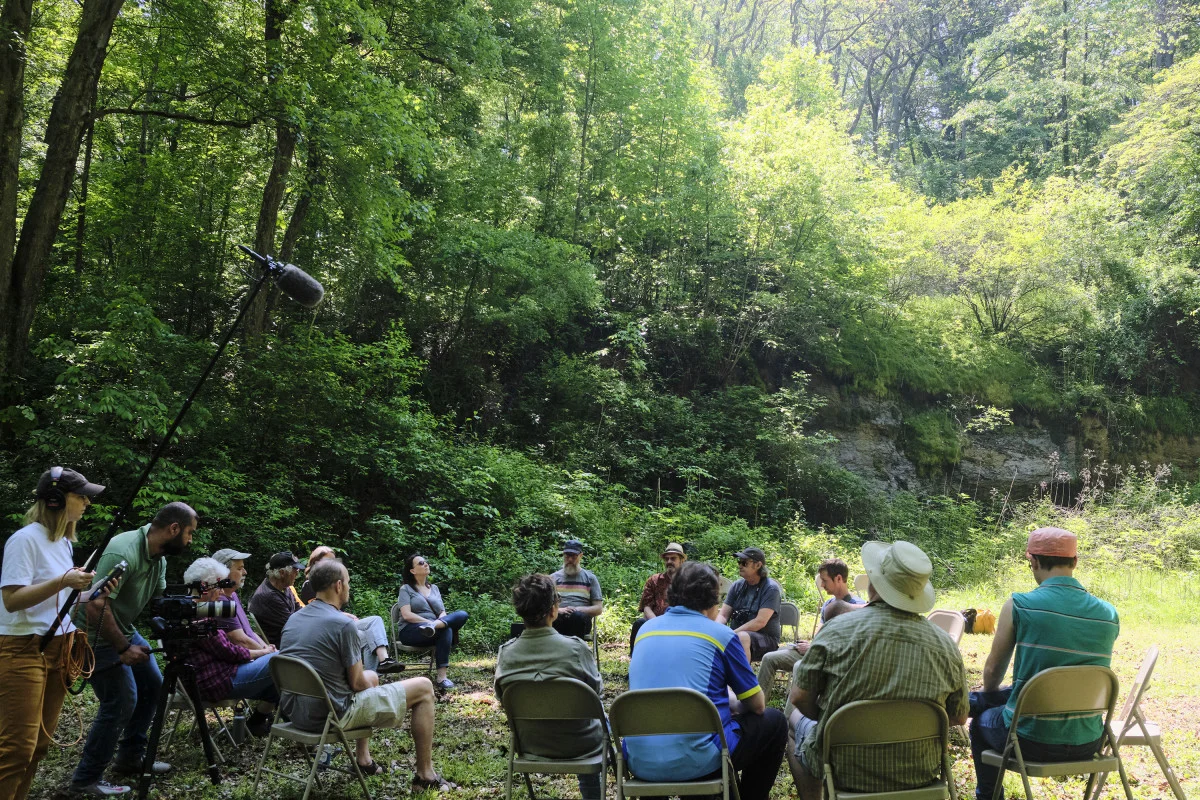
Photo by Julian Foglietti for Columbus Alive and Pacific Standard
“Harnetty has invited people from the Little Cities of Black Diamonds—from traditional environmentalists to lifelong drillers—to take part in a radical act of listening in hopes of finding literal common ground via their shared love of the land. The forest itself is the mediator. Maybe, Harnetty argues, if we listen to the forest together, we can alter its future.”
“Studs Terkel meets Brian Eno in the woods.”
“A Blade of Grass Fellow Brian Harnetty is an artist who chose to stay... His commitment to place is a radical choice, in the original sense of ‘radical,’ meaning to have roots, specifically to share the experiences and concerns of communities to which we are accountable.”
“After the first session happened, it became more apparent than ever that the activities of walking through the forest initially, being present there, hearing the archival voices and particular opening observations, in combination with the participants sharing life experiences, created an intimate situation that refocused the questions asked and transformed the listening, generating an energy whose potential was much larger than that just created by the hearing itself. ”
“What do our National Forests sound like? And how do they make us feel? ... [Harnetty] uses the Wayne National Forest as a venue for a dialogue around American rural life and the land we live on.”
“Harnetty’s light touch allows FLR to speak what Robin Wall Kimmerer (botanist and member of the Citizen Potawatomi nation) might call the ‘grammar of animacy.’ Kimmerer writes that when our language honors the animacy of all life forms—including those that English-speakers are used to describing as inanimate—we are able to come into relationships of reciprocity rather than exploitation. In FLR, we see one vision of this—as Harnetty puts it, participants envision a world in which ‘we could actually help change the place, to heal it, even at the same time as it was changing us.’”
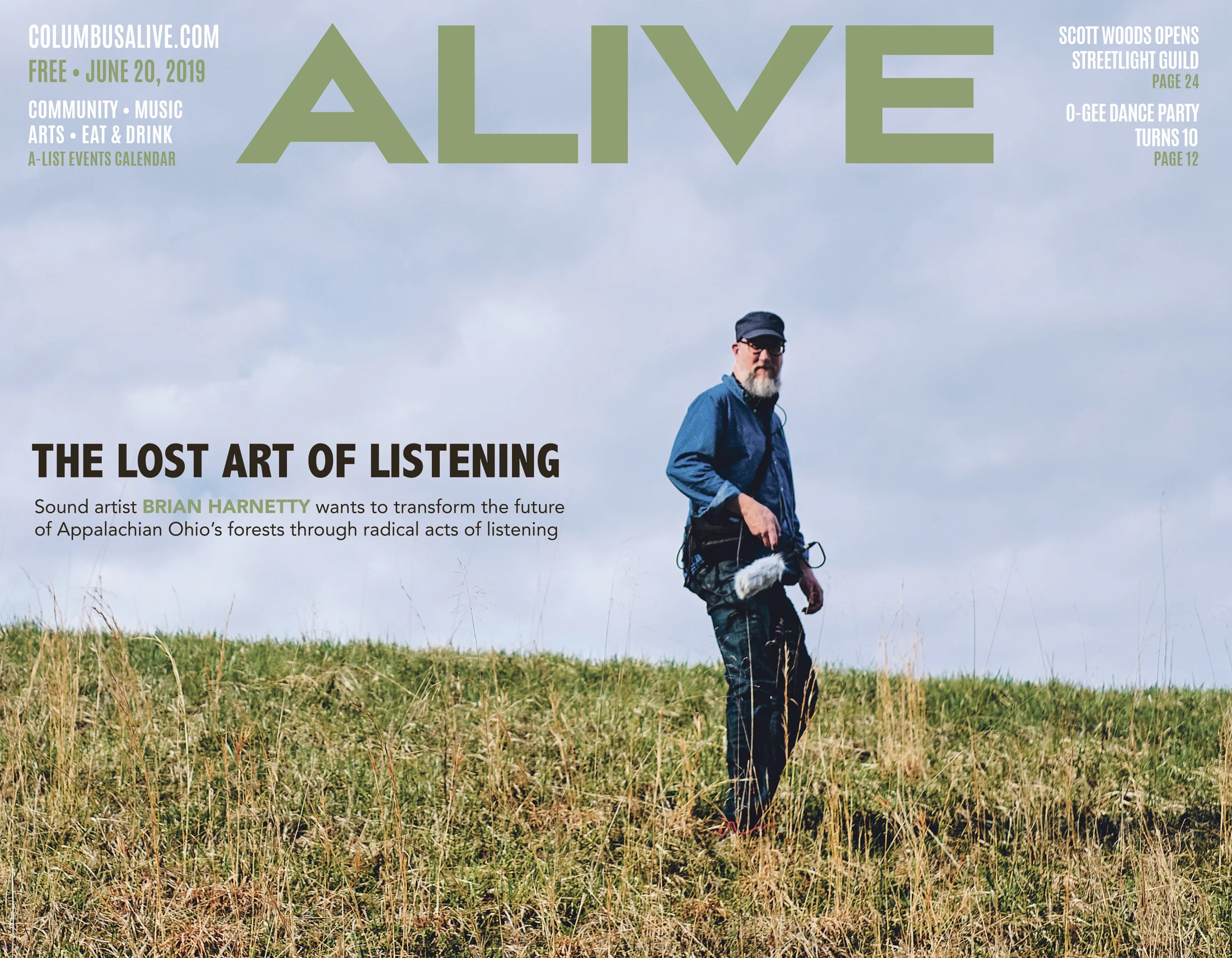
The Lost Art of Listening: Sound Artist Brian Harnetty wants to transform the future of Appalachian Ohio’s forests through radical acts of listening
A collaboration between Columbus Alive and Pacific Standard
Joel Oliphint, June 2019
"OK, so we'll just listen for a few minutes."
Brian Harnetty sits in a metal folding chair in a clearing at the base of Robinson's Cave in Wayne National Forest, which covers nearly a quarter million acres in the Appalachian foothills of Southeast Ohio. About 20 others join Harnetty, seated in a circle on a warm, humid Saturday morning in May, their chairs slowly puncturing the soft ground.
For more than 10 minutes, no one says a word. It takes a bit to settle into the quiet, to live in it comfortably, but soon the vibe becomes meditative. It feels like a ritual. Some people bow their heads. Some fold their hands and close their eyes. Others scan the woods that surround the clearing.
A sycamore partially shades the circle of listeners, dappling sunlight into the middle of the ring. As the wind blows, the swaying branches and quivering leaves of countless trees create a kind of woodwind symphony. Someone's stomach growls. A dog barks; it sounds enormous and menacing. The trill of a red-bellied woodpecker dominates an improvisational chorus of birdsongs. At times, motorcycle engines temporarily take over as they cruise along Main Street in New Straitsville, a town known for its Moonshine Festival that sits just below the clearing…
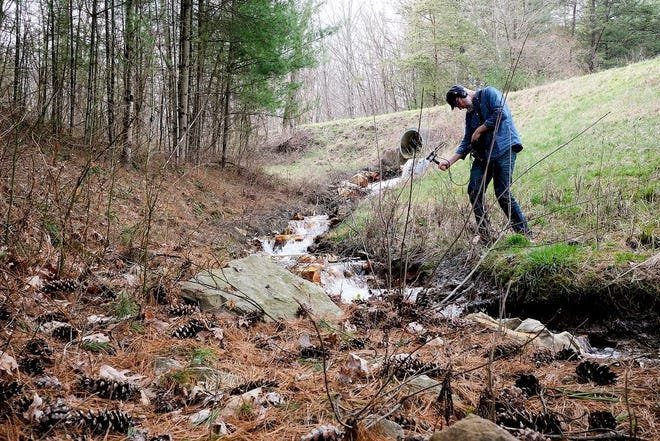
Photo by Julian Foglietti
Enter the Forest with Brian Harnetty
Columbus Alive, December 2021
Back in the summer of 2019, Alive took readers on a journey into the woods with multidisciplinary Columbus artist Brian Harnetty, who created a project he dubbed Forest Listening Rooms.
"It’s basically like, ‘There’s this crazy dude who’d like to go out to the forest with you and just sit and listen,’” Harnetty said at the time.
Since then, the 11-year project, which came about through relationships Harnetty developed with folks in Appalachian Ohio (and particularly in Wayne National Forest), has evolved and grown. Recently, Harnetty made an installation version of Forest Listening Rooms for the Columbus Museum of Art, and last week, he released a remixed and mastered version of the installation's soundtrack on Bandcamp.
"On this recording, you’ll hear the voices of past and present local residents of the forest in Appalachian Ohio," Harnetty said in a statement about the 13-minute track. "They recount their love for the land, memories of the past, disasters and underground mine fires, economic and political struggles over mining and extraction, and their hopes for the future. You’ll also hear field recordings of the natural environment of the forest: a spring chorus of pre-dawn birds, summer drones of insects, and faint autumn sounds of wind and rain on brittle, fallen leaves. Finally, you’ll hear the sounds of an ensemble of seven musicians, whose long tones and static, ambient harmonies complement and interact with the environmental and human sounds already present."
One of the featured voices belongs to Perry County resident Joelene Dixon, whom Harnetty interviewed the day I accompanied the pair into the forest. As Dixon stared out across Essington Lake, she began to reflect on her relationship with her family and with the land, and how the two are inextricably linked.
“My parents are gone. And after my dad died — my mom died first — and after my dad died, I wasn’t quite ready for… the feeling of being an orphan," Dixon says in the recording. "And something about being in an area that is familiar to you, that reminds you of your childhood, reminds you of carefree days, is comforting. I don’t know how else to say it, it’s just comforting. It’s home.”
— Joel Oliphint, 2021

Stay, Listen, Organize: Bridging Appalachia’s Past and Present through Sound
A Blade of Grass Magazine, Issue 2, “Who”
Robert Sember, April 2019
A Blade of Grass Fellow Brian Harnetty is an artist who chose to stay. Born into a multi-generational Appalachian family in southern Ohio, his work as composer, musician, and sound studies scholar is both inspired by and addressed to his local communities. His commitment to place is a radical choice, in the original sense of “radical,” meaning to have roots, specifically to share the experiences and concerns of communities to which we are accountable.
Brian uses a deceptively simple practice to root himself in place and community: he listens. He has listened for close to twenty years, which has enabled him to realize a remarkably diverse collection of compositions, recordings, and writings. His latest work, Forest Listening Rooms, brings together residents and workers from rural Appalachian Ohio for collective, site-specific listening sessions. In these events, listening is a tool for community organizing…

Harnetty interviews Joelene Dixon in the Perry State Forest, Ohio
The Sounds of Rural America
Published by The Daily Yonder and 100 Days in Appalachia
May, 2019
An audio project set in Appalachian Ohio expands the idea of “listening to each other” to include natural soundscapes and audio archives. Composer and artist Brian Harnetty says such listening is one way to bridge differences in perspectives, politics, and place.
I spend a lot of time listening to Appalachian Ohio. I listen to its people: bakers and shopkeepers, community organizers and coal miners, farmers and fracking protesters, and they all have a story to tell. I listen to places, too: forest hemlocks and sulphury streams, warblers and spring peepers, oil wells and local industry, as they come together to make the region’s soundscapes. Just as importantly, I listen to sound archives, where I hear voices and songs of everyday people; I am eavesdropping as sound and history collide.
I transform these sound archives into new music. For the past two decades I have worked as a composer and ethnographer to figure out a process and a language to do so. I have worked with archives across Appalachia and the Midwest from Kentucky to Chicago. They have included everything from 90-year old ballad singers to the ruminations of jazz visionary Sun Ra. In this work I am striving toward a new way of listening that involves careful attention to both old recordings and contemporary voices. The projects look back and perform history, but invariably they also lead me to the present moment.
Making music from archives helps me develop an understanding of complex cultural and social relationships that inform both rural and urban places. …

Composing Sociality: Toward an Aesthetics of Transition Design
Jeremy Woodruff, from the The Bloomsbury Handbook of Sound Art
Harnetty’s work shows how composing sociality thrives through returning again and again to a community over a long period of time, with the commitment of an artist who maintains a presence, building trust over years, unlike the typical time frame of socially engaged artworks where an artist or collective moves in and then quickly out again. … After the first session happened, it became more apparent than ever that the activities of walking through the forest initially, being present there, hearing the archival voices and particular opening observations, in combination with the participants sharing life experiences, created an intimate situation that refocused the questions asked and transformed the listening, generating an energy whose potential was much larger than that just created by the hearing itself. … Listening brings us viscerally out of rationalizing away systematic destruction and face-to-face with the impact and bond the natural environment has in our lives.
“A Community is a Garden” from the Guggenheim Environmental Justice Practicum Sustainable Futures


Download a PDF version here.
Kanyinsola Anifowoshe and Mikki Janower
December, 2020
…It is perhaps difficult to imagine the silence that Forest Listening Rooms participants encounter—the absence of noise that creates space for another kind of presence. Cheryl Blosser, a local historian and FLR participant, notes, “It seemed to me that [Harnetty] was being very careful not to influence you too much. He wanted what came out of the conversations to be mostly let in by the silences or the sounds of the woods or the other people. A lot of what he did was to just let us feel and talk about what we did feel and whatever memories those brought out.”
Blosser’s comments highlight that by stepping back rather than stepping in, Harnetty creates space for the forest’s sounds and silences to guide the conversations. In FLR, land is a form of active life rather than a static background—which Harnetty emphasizes by letting the land’s many histories speak.
Harnetty’s light touch allows FLR to speak what Robin Wall Kimmerer (botanist and member of the Citizen Potawatomi nation) might call the “grammar of animacy.” Kimmerer writes that when our language honors the animacy of all life forms—including those that English-speakers are used to describing as inanimate—we are able to come into relationships of reciprocity rather than exploitation. In FLR, we see one vision of this—as Harnetty puts it, participants envision a world in which “we could actually help change the place, to heal it, even at the same time as it was changing us.”
Through communion with the land, we learn new ways of being in community with each other: as Harnetty observes, “The forest itself becomes a mediator between people that might think differently or have different cultural backgrounds or are even on different parts of the political spectrum. It opens up the conversation so that participants are much more engaged and open with one another. That’s the point where something can really change between how people perceive each other.” By building connections across lines of difference, the forest provides roots for a community not of superficial unity, but of multifaceted togetherness.
For Harnetty, facilitating this community required him to be open to shifting the conditions of the work in order to reach those who may have not been immediately sympathetic.

If a Musician Plays in a Forest: How the Sounds of Our National Forests Make Music
Matt Harmon, National Forest Foundation
If you search “forest sounds” on YouTube, you’ll find hundreds of hours of forest ambiance to help you wake up, meditate, work, sleep, or any other activity where you want to pretend you’re among the trees. But these videos could be any forest. What do our National Forests sound like? And how do they make us feel?
Luckily, a few world-class musicians and scholars have set out to create albums and auditory maps based on our National Forests. During their research and community outreach programs, they found that National Forests hold a special place in locals’ hearts and ears.
Brian Harnetty is an interdisciplinary artist that uses archival material and music to create sonic compositions that reflect communities. His album Shawnee, Ohio was inspired by his family roots in the town where the Midwest meets Appalachia.
Shawnee, Ohio combines archival interviews with residents of the rural town, new musical compositions, and field recordings from the Wayne National Forest to tell the stories of past Shawnee residents and their relationship to the land around them.
“The connection between real people and an archive made, for me, archives come alive. I often think that archives contain everything except a living interaction so any way to make the objects within an archive come alive, that’s where the magic happens,” Harnetty said.
With tracks like “Jim” talking about life in Shawnee, “Boy” interviewing his grandmother about mining, and “Ina” singing local folk songs, all with Harnetty’s field recordings and instrumentation underneath, Shawnee, Ohio uses the Wayne National Forest as a venue for a dialogue around American rural life and the land we live on.
While the album speaks for itself, Harnetty didn’t want the engagement with Shawnee to stop at the archives. As a part of the overall project in 2018, Harnetty and Shawnee residents went on guided walks into the Wayne National Forest and participated in what Harnetty calls Forest Listening Rooms.
“The idea is to use listening and the forest itself as a mediator to allow new kinds of conversation and connection to take place. By listening to the forest and listening to each other and then having guided conversations about land use, [we all realized] the shared interest in the land itself and its history. There’s a large labor history there … Eventually [we can] imagine the future as well and ways the forest might look in the future and how we might benefit from it and how we can protect it,” Harnetty said.
Harnetty hopes to continue the Listening Rooms once it is safe to do so. The walks consist of designated stops to sit and listen, sometimes in silence and other times with accompanying tracks from Shawnee, Ohio. Harnetty said the forest and the silence you rarely hear near so much industry allowed for those deeper conversations to take place.
“At the end of 15 or 20 minute or half an hour of silent listening, the mood dramatically changes. It feels almost giddy. … In the end, it makes it very easy to talk about ways to protect the land and to tap into those feelings of being proud about the land itself. … I really felt like the trees and the forest itself became in between us. We were listening to the forest but the forest was changing us in turn,” Harnetty said. Shawnee, Ohio utilizes musical compositions in addition to field recordings of the forest to set the scene.
An interview with Brian Harnetty and Mary Lucier, 2021
The Hoosac Institute
Anna Talarico
In 1970, artist Robert Smithson created Partially Buried Woodshed on the campus of Kent State University, covering an abandoned woodshed with soil until its central beam cracked. Unsettling traditional notions of landscape and environmental art, Smithson’s project also addressed a connection to Ohio’s Indigenous earthworks, many of which were destroyed—or willfully overlooked—by white settlers during the Frontier Era.
In the decades since, artists have continued to approach Ohio’s landscape as a site and a subject, challenging the conventional representations of the state’s history and cultural legacy. Gathering works from a diverse group of artists, Partially Buried: Land-Based Art in Ohio, 1970 to Now—an exhibition on view now through November 28, 2021 at the Columbus Museum of Art—grapples with the state’s history as a former frontier territory, confronting unanswered questions around land use, interpretation, preservation, and representation.
Curator Anna Talarico spoke with Brian Harnetty and Mary Lucier, the exhibition’s two Ohio-born artists. Partially Buried: Land-Based Art in Ohio, 1970 to Now features Harnetty’s sound installation Forest Listening Rooms (2018-present), and Lucier’s video, Ohio to Giverny: Memory of Light (1983). The artists reflect on how Ohio has loomed large in their practices and their intersections with environmental and social justice. The conversation that follows has been edited for clarity.
***
Anna Talarico (AT)
Mary and I were just chatting about the last time she was in Columbus because she showed Ohio to Giverny: Memory of Light at the Columbus Museum of Art several years ago. I was saying that my mom grew up in Van Wert [Ohio], and my dad is from the Ohio River-steel town area near Steubenville, so they come from two very different parts of Ohio with interesting histories. I'm curious to hear about your families and your Ohio origins.
Brian Harnetty (BH)
I'm from Westerville (near Columbus). But both of my parents’ families are from southeastern Ohio — Perry County — which is part of Appalachian Ohio. My dad is from Junction City and my mom's family is from Shawnee, Ohio, two small rural towns. So, Appalachia looms large in my in my mind and in my memory, but I don't identify as Appalachian. I do have a kind of introduction card for meeting with communities there. And they trust me a little bit as an outsider because they knew my family. My mom's family came as Welsh coal miners to Shawnee in the 1870s. And then my dad's family is mostly Irish, working as farmers and in the local clay mills. How about you, Mary?
Mary Lucier (ML)
Well, I come from Bucyrus, which is about 60 miles north of Columbus, 90 miles south of Cleveland, in the middle of nowhere. Very small town, one of those places where everybody knows everybody else. At least they know their family background, and they all know about one another. My father was from Marion [Ohio], and my mother was born and grew up in Bucyrus. She went to Columbus School for Girls, which was a boarding school. We have a long family history of descendants on my mother's side who lived in Bucyrus. They originally came over from Scotland, I believe, and somehow settled in Bucyrus and established lives there. My mother, when she was quite young, traveled in Europe for a while and married a German man and had a child, my sister, who lived in Columbus. I went to Brandeis and stayed on the East Coast and have been here ever since. Mostly in New York City. I was obliged to leave [Ohio]. My mother basically said, “get out of here.”
AT
What was what was [your mother’s] context for you to “get out of” Bucyrus?
ML
Our family was very literary. Many of them were extremely well educated and had gone to good colleges. And my mother's idea for both my brother and me, was that we should go away, that there were no prospects for us, certainly not in Bucyrus.
BH
Well, at the time, I couldn't wait to get out of Ohio! I did my undergraduate at Ohio State, and then worked for several years and travelled a lot, and then did graduate work in music composition at the Royal Academy of Music in the UK. I had always planned on staying in Europe after graduating, but I had a conversation with one of my teachers, Michael Finnissy, where he thought that there was something that I needed to address in Ohio, some kind of story about myself and Ohio as a place that he thought I should return to and dig deep into. So I took him up on that challenge (thinking it was only temporary), and then over the years, I've just spent all of my time focusing on local issues through the lenses of listening and sound: place, energy extraction, and social and environmental justice. I also found myself working in Kentucky often, with Appalachian communities and archives. I brought these experiences back to Ohio and made Appalachian Ohio my subject, and as a place to base my work. It's exactly where I thought I wouldn't be twenty years ago! But I am glad it has turned out this way.
AT
It's something that's interesting about Ohioans—there's always this strong sense that you can never really leave Ohio. Ohio is just so part of your identity. Because I have such a strong family history in the state, that was really something I started to think about when I was invited to curate an exhibition at the CMA: how can we artistically represent Ohio? How has Ohio been a site and a subject [for artists]? Mary, is that desire to leave, to get out of Ohio, the driving force behind Ohio to Giverny: Memory of Light?
ML
Most American artists at some point must come to terms with European art history. But until relatively recently, European art was placed on a pedestal, and it wasn't until Abstract Expressionism that American art became the dominant visual art, in the Western world. Back in 1982, when I started this piece, I was thinking about the fact that I had been to Europe before I ever traveled west of the Ohio River. I had traveled to Europe, before I ever saw the United States, except for Ohio and Massachusetts. I had also seen a show [in 1978] at the Metropolitan Museum of Art called Monet’s Years at Giverny: Beyond Impressionism, and I discovered something in his work that I had not really known before. I'd always thought of those iconic images as pretty but not terribly interesting. Then I began to see his later work in which there is a lot of blank canvas and gestural brushwork, and suddenly you see this man is in a hurry. I found out later, his eyesight was failing, his health was failing. He apparently used to paint facing the sun, and I was shooting video facing the sun, which defaced the camera tube. (That's a whole other story.) He was like a man rushing through the final body of his work as his vision failed. If you look closely at those paintings, you can see areas that are very close to Abstract Expressionism. And then there was the personal story. My uncle was a small-town lawyer in Bucyrus, and he and many of my close relatives all made their maiden voyages to Europe when they were quite young. Of course, they went by ship. I distinctly remember my mother's story of my Uncle Bill, leaving a train on a train from Crestline, Ohio to New York. The scene [my mother] described to me was [Uncle Bill] taking out his toothbrush and waving it to them as the train took off. So, I had this childhood image of a man who had taken a train to Europe. If you listen to Ohio to Giverny: Memory of Light, you will hear train sounds throughout. That was the basis of the work: the personal story, the condition of American Art arising out of European and the dilemma of every American artist's confrontation with European art up to that time.
BH
Now, when I saw Ohio to Giverny: Memory of Light, I saw a lot of meaningful confusion between the two places, and I kept thinking about how the places where Monet worked are so storied. At the same time, I was finding the landscapes of Bucyrus just as visually compelling. You might have something else to say about the quality of light — because I know that's what a huge part of that piece was all about — but I just kept thinking about senses of place and wondering how much that might have factored into it.
ML
The first part takes place in Ohio. But once the camera effectively goes out the window, you arrive in Paris. And from then on, it's France, except for the very end after the dedication, "a mon Oncle" on a tombstone; the last pan of the camera is back in Ohio farmland.
BH
I just keep thinking there's a well-known mythology about France, in relation to the footage of Bucyrus. And the footage in Bucyrus creates a different mythology around what it is to be there. I appreciated that because it leveled out the playing field, as it were; you're reconciling your own history with European history and these other larger cultural centers in history, through landscape. So, I very much appreciated that quality, because if you come from a place such as Ohio, you often feel like you have to prove yourself, or you have to do something in a larger cultural city to be able to compete, or to have a voice, or have something to say. For my own work, I grapple with these ideas, but I also think that the most ordinary of people and overlooked places might have extraordinary things to say and offer — so I work to tell those stories and find a way to make them as compelling as possible. Then, the archival recordings that I use give context to environmental problems, labor struggles, and natural resource extraction issues, and all of these things that play into Appalachia more broadly. Ironically, I think focusing on these issues and senses of place give me something relatively unique to offer.
AT
As I was thinking about the exhibition, and how I wanted to present these artistic representations of Ohio, I was struggling with these conflicting perspectives of the way the world sees Ohio and the way that I see Ohio. Brian, I’m hanging on to what you said about feeling like you have to prove yourself if you're from Ohio. That struggle is what drew me to think about art from this area, because it obviously has so much more to say beyond the kinds of stereotypes that are widely accepted about the state. At the same time, I came into the exhibition with a very keen awareness of colonial histories in the state and the Indigenous history that preceded Ohio statehood. That is a huge part of what [the exhibition] raises awareness about, in terms of the relationship between the land and Ohio and its culture, people, economic, and industrial histories.
ML
My work has primarily been based in landscape since the ‘70s and pretty much even through the present moment, I think that I've been asked many times why. I can only think that it has something to do with my growing up in this small town that was surrounded by farms and forests, and laden with anecdotes, stories, and tales about Indigenous Native Americans. Think how many of the towns and rivers have Native American origins in their names, and how the stories are passed down about those people, or about their descendants. For example, [Bucyrus’] athletic teams were called the Redmen. I don't think “Redmen” is a term one can use anymore or should use. But in fact, there was a great deal of respect among the citizens of our little town for the notion that the red man—the Native American—was a very special and powerful person. That was interesting to me on another level. But I do think that those landscapes—and the fact that all I had to do was to ride my bicycle 10 minutes and I'd be out in the middle of cornfields, or I'd be in a forest—have something to do with my later preoccupation with aspects of landscape in my work. I remember flying home from shooting in the Brazilian Amazon: suddenly, you hit the United States, and you're looking down at this fertile land that's filled with crops and cattle, and one thinks, “what, what an incredible difference there is between [Ohio] and a place like the Amazon, where we actually believe the world needs the forest, but they don't want it. They want it to be like the Ohio wheat fields.” When I think of Ohio, I think of that rich, productive landscape.
AT
As I was preparing for the exhibition, I did some research on the Ohio Valley region and why there were so many thriving Indigenous communities in this area for thousands of years. And the very reason is because of the fertility of this area, and the access to river ways.
ML
Today, if you go down the Ohio River, ecological conditions get worse and worse. If you start out in Youngstown and head south along the river you get to Chillicothe where it's filthy. The air is polluted from the paper plants and other big factories that sit right on the Ohio River, which becomes a dumping ground. It's quite devastating, in many ways.
AT
What's so important about both of your practices is that address different kinds of histories and trauma that the land has faced, not only culturally but also socially. And that's something that I didn't realize we would unearth in the exhibition, but it truly does come through in each of the works. Despite the environmental devastation inflicted onto the land, the collapse of many industries in Ohio—as well as the economic stability that they provided—is something that the exhibition emphasizes. There’s a strong sense of, what do we do now?
BH
The piece that I've been doing as a social practice project since 2018, Forest Listening Rooms, is trying to listen to the past and present, in order to do just that: figure out what to do now and into the future. As part of that focus, it addresses labor history and environmental and economic decline in southeastern Ohio. One of the towns that I work in is called New Straitsville, and in the 1880s warring labor groups came together there in secret to create the United Mineworkers, to have a unified voice against the mining companies. And in researching and celebrating this history, I learned that you can be opposed to extraction and mining, but also appreciate that the long history of labor in the region. In addition, Appalachian Ohio is more diverse than what people think: there were lots of different miners coming from all over the world, and they would often have their own small little towns, and many are gone now. Importantly, looming over everything is the Native American history. Because I am a sound artist, I often use archival recordings as material for my work; but here, all Native Americans were forcefully removed from Ohio some forty years before recorded sound was even invented, so there's a huge absence in recorded media of any Native American record in the region. I think my frustration in looking for a sonic history of a place is that Ohio, in so many ways, seems silent when it when it comes to those peoples.
And yet, there are some good stories, too, albeit complex. One thing I am fascinated with now is that despite the old growth forests of entire region of Appalachian Ohio being completely clear cut by the early 20th century, the forest has returned. Through a New Deal program in the 1930s, the whole area was designated a national forest (despite not having any trees). Now, almost 90 years later, we have our state’s only National Forest. To me, this forest in southeastern Ohio is now like a huge social sculpture. It's so rich, and it has so many contradictions in it. It's very fascinating to work with as a subject.
AT
One of the reasons why I wanted to call the exhibition “Partially Buried” is because Robert Smithson's Partially Buried Woodshed really was the trigger for these questions I had about art, the landscape culture, history, politics, and the environment. I have done a lot of research on Robert Smithson and his interest in Ohio as a site, which led me to his proposed earthwork for Egypt Valley, which is just about an hour east [of Columbus] on [Interstate] 70. The work never came into fruition [during] planning stages with mining companies that were obviously abundant in the area. But what came from Smithson’s involvement in the area was a real acknowledgement that the land can never return to its pre-mining state. So, what can we do with the resources that are available and the state that [that the land] is in? That's an exciting thing that I think the exhibition realizes.
BH
I think that Smithson’s proposed, but unfinished work is a good example of how these types of projects require huge political and social efforts to be able to come to fruition. My own project, Forest Listening Rooms, is on a much smaller scale, but built over a much longer period of time, and is trying to address those issues you're talking about very directly. Forest Listening Rooms is a sound piece that’s built with components from a long tradition of composers and sound artists. My main audiences are local residents of the small towns in Appalachian Ohio. We first take a sound walk into the Wayne National Forest, following the traditions of John Cage, Pauline Oliveros, Annea Lockwood, and so forth. We then walk to specific locations to sit in the forest, or “rooms,” and just be quiet and listen in silence for fifteen or so minutes. After that, I share archival recordings of people from the past that lived in those very places. The people on the recordings tell their stories about labor, place, and destruction. And then after that, we have a guided conversation about the land: public versus private land, extraction, and about how the land should be preserved or used in the future, all in an effort to end fracking within the Wayne National Forest. And again, many of these people are local residents who are on the opposite end of the political spectrum from myself, but they are the people that I really want to reach out to. And what I found was the process of walking and listening in silence, followed by listening to the cautionary tales of past residents — perhaps even in some cases their own ancestors and relatives — and then talking about the land candidly, it opened a new way, a new space for conversation. It wasn't about opposites clashing, it was about finding some common — literally, common ground — over the land and a sense of pride in the land. For example, I would go out with hunters, and again, stereotypically, they would often be much more politically conservative than myself. Yet they have a great love for public lands and are very happy to have national forests and lands to use sustainably for hunting. So, I found unusual allies, as it were, across these political divides. But I think it was all facilitated by the forest itself, and the trees became something like mediators between the different people from these communities. So, I think it touches on what you're talking about with imagining new futures, but you must do it through a sense of commonality; something has to be common between us.
AT
There is some degree of co-production and co-exchange between the artworks in the exhibition and the land. That's not something I had realized until you just put that spin on it. This makes me think about how many works in the exhibition grapple with achieving a true history or real history. Most saliently is the extraordinary photograph that Dawoud Bey captured in Northeast Ohio. It's not an exact, pinpointed location [along the Underground Railroad]; rather, Bey approximates the location from careful research. So, in thinking about the exhibition in that context of these partially buried, partially uncovered histories, there's an element in the exhibition of never knowing the whole story about what happened in the land.
BH
I think that Dawoud Bey’s photograph is capturing an essence of the whole exhibition, and it works very well in uncovering these hidden histories. In southeastern Ohio, for example, there's an underground mine fire that's been going on since the 1880s. And it's almost impossible to find it. Maybe in the wintertime, you can see that if there's snow on the ground, there's probably a patch that's melted, and maybe that's where the fire is. So, in searching for this hidden history, I would often go through a process of asking myself, “what is the sound of the mine fire and how might I find it that way?” I could never find out exactly where it was. And yet the searching, the looking for it and trying to find it became part of the work — it’s reminiscent of Tacita Dean's From Columbus Ohio to the Partially Buried Woodshed — where her search for the woodshed is the work itself.
ML
Verité is one thing, and it’s essential for documentarians. However, sometimes one can run into trouble in the art world when you have work that has one foot in what I call documentary—which is more about the examination of facts, and interviews with people, their stories, their histories, usually backed up by a lot of research—and then have the other foot in something that is evocative of those things but doesn't actually make a political point. For me working on Ohio to Giverny: Memory of Light with one toe in documentary and one whole foot in video art, I sometimes ran into this issue of whether anybody was "getting" it. Was anybody really understanding? Because this was an installation of two channels of video on seven monitors, it had a wide sweep, and it had a big impact, visually and auditorily. It became incredibly popular, but there was also this undercurrent of political distaste for what I had done. I really don't know what the feeling is now, I only know that MoMA hasn't shown the tape in a million years, and the Whitney has not shown the installation in a million years, because it's completely out of vogue, partly because it's been misunderstood. Even people who sensed that there was a personal narrative in it said one could do without that. And they were the ones who were pro-Monet. And then those who were anti-Monet, didn't see any anything personal in it. They just saw this bourgeois phenomenon of Impressionism. There was one curator/critic, Bruce Jenkins, who is one of the very few writers who got what the piece was about, that it was about the interface between the technology of video and the technology of Impressionism and dealing with the quality of light and the way the light entered Monet’s eye when painting facing the sun. But in fact, the two processes were very closely related, and that's what I was investigating, as much as the personal story that I used as the hook to lay my images on. Maybe it was too complex for people because it looked so simple. Maybe it looked too pretty. I don't know. I don't think it would look that pretty today. You can't anticipate people's perceptions, how they change over time, and how the perception of an artwork can shift over time
AT
I hope that those ideas in Ohio to Giverny: Memory of Light are a little more evident because of its inclusion within the exhibition’s context about the landscape and the culture and these histories in relationship to each other.
ML
That's a good thought. It's a very good thought. And it removes it from that other context: beauty.
AT
I interviewed Michelle Stewart, who's another artist featured in the exhibition. What's wonderful about Michelle is that she stands out in the exhibition as one of the true foundational land artists, if you will, so she is within the same realm as Robert Smithson and Nancy Holt, among others. She said to me that the legacy of land art is environmentalism, and to encourage reverence for the land and its resources.
ML
[Michelle Stuart] is a wonderful artist. I see some of what you're talking about Brian, up here in upstate New York as well. We still have some hunting, and we have an enormous deer population. When I first moved up to this region, people were very poor, and the people who hunted were those who really needed the deer meat to get through the winter. I came to understand that there were those who desperately needed to have a freezer full of venison for the winter, though it's not so true anymore. There are so many different sides to the whole notion of hunting.
BH
What you're describing gives a sense of local history. And because you've lived there for a long time, you have been able to observe it over many years and see how it's changed. Time, to me, is so fascinating. I think this is a way socially engaged art and land art can come together: it is this element of time, and observing places and people over years and decades, and having a set of relationships and friendships with them — all of this can influence your work in really interesting ways. In one sense, I feel like in some small ways I am affecting or even altering the places where I work in Appalachian Ohio. I'm part of some small changes there, working with people as an artist and community organizer. But the people and the places are absolutely affecting my work and changing it, too! And that exchange is what I'm really after.